
Show summary Hide summary
Ever wondered why the Maya people went to the trouble of putting colorful stones straight into their teeth? Was it just to look fabulous, or were they playing 4D chess with dental health centuries before modern dentistry? Spoiler alert: it wasn’t just about dazzling grins. Recent discoveries are shining a very bright—and rather colorful—light on the profound sophistication of Maya dental practices.
Glittering Grins: More Than an Ancient Fashion Statement
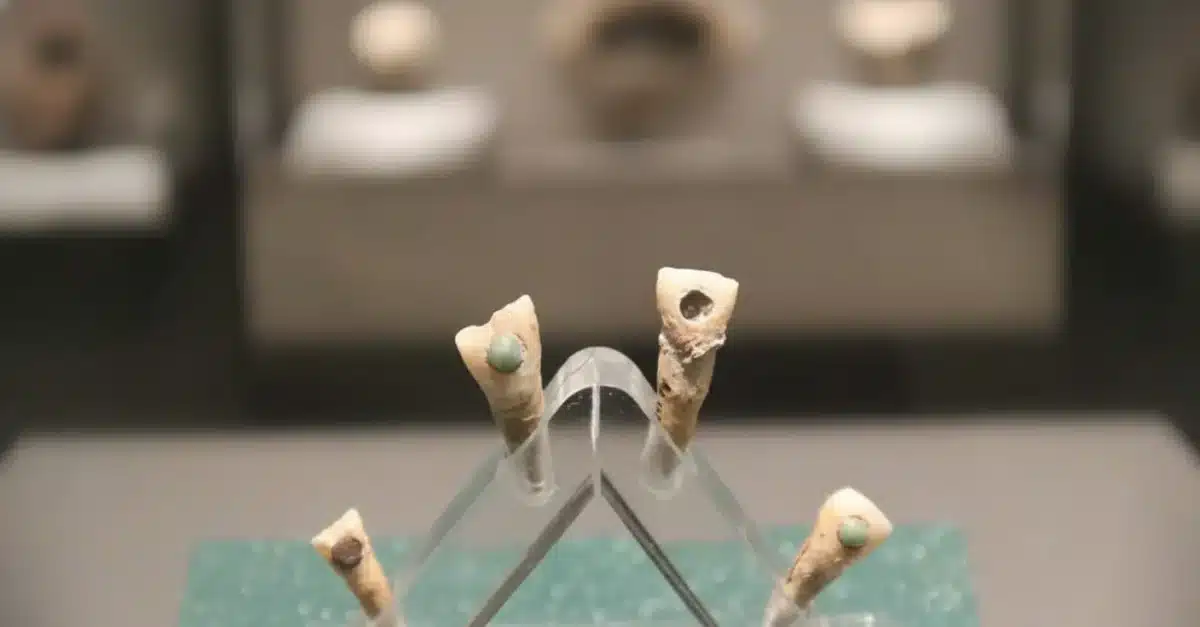
Archaeologists have uncovered numerous Maya skeletons whose teeth sparkle with jade, turquoise, and even pyrite inlays. These weren’t a random dazzle—think green jade buttons, blue turquoise, and glittering gold-silver pyrite, arranged so artfully that you can picture their proud owner grinning from the afterlife, as if to say, “Yes, my teeth really do match my headdress.”
But these weren’t merely accessories worn by the wealthy to outshine their neighbors. Research has revealed that men and women, the rich and the not-so-rich alike, sported these dental ornaments during the so-called Classic period (250 BCE – 900 CE). This ritual was more than a passing fad: it was part of a deep-seated cultural and possibly spiritual tradition, richly embedded in Maya society.
Eggs every day for months: simple check reveals shocking blood test result
Popular childhood food ingredient may raise adult anxiety: study
Ancient Dentists: Artists and Innovators in One
If you think your dentist has a tricky job, spare a thought for the Maya dental artisans of yore. They managed to carve out tiny cavities into the tooth enamel and dentine, placing stones in without cracking the tooth—now that’s skill! Whether embellishing a single tooth or dazzling up an entire row, these inlays have survived the centuries, testifying to the resilience and precision behind the work.
What’s truly remarkable isn’t just the bling, but how it was secured. The secret sauce, as it turns out, lay in the glue. Analyses have shown this special adhesive contained ingredients reminiscent of cement and a mineral called hydroxyapatite—elements that not only hardened the glue but actually reinforced the drilled tooth. No quick fixes here: these were dental solutions built to last.
But for a long time, scientists scratched their heads about which ingredients gave these glues their remarkable binding power. Filling this knowledge gap, a recent study published in the Journal of Archaeological Science: Reports took a closer look at eight ancient Maya teeth from three archaeological sites in Guatemala, Belize, and Honduras. None of these belonged to high society—just regular people keeping up with the latest dental trends of their era.
Sticky Business: The Science Behind the Stone
What the researchers found is, frankly, a botanical who’s who of the ancient world.
- They detected about 150 organic compounds from various plant resins.
- Pine-derived ingredients featured heavily, with past studies showing these could fight off bacteria known for causing cavities.
- Some samples had traces of sclareolide, a compound from the Salvia genus (yes, the same family as sage), known today for antifungal and antibacterial powers—plus it’s used in the perfume industry, just in case you wanted your mouth to smell fabulous, too.
- Essential oils from mint family plants were also present, possibly adding another antibacterial twist.
The adhesives could be classified into four groups linked to their origin, but their core ingredients remained consistent. According to study co-author Gloria Hernández Bolio, each ingredient had its own job—no freeloaders in these ancient dental glues!
What’s more, the study’s findings suggest these adhesives likely possessed both antibacterial and anti-inflammatory qualities. Take that, dental plaque!
The Maya Tooth Tool Kit: Not Just for Show
Now, was all this intentional? Did Maya people know they’d invented the ancient equivalent of antibacterial glue? Honestly, the jury’s still out. The most important trait to the Maya seems to have been the glue’s mending properties—after all, a stylish smile is no use if it falls out. Yet, given that some of these plant ingredients are still used by Maya descendants today, there’s a good chance their ancestors understood at least some of the medicinal perks.
And the ancient Maya’s dental mastery didn’t stop at gemstone bling. Other skeletons have revealed well-polished teeth, with some even showing evidence of extractions when cavities got out of hand. So, it turns out, Maya dental practitioners were tackling both aesthetics and health in a way modern dentists might envy.
Their practices weren’t just reserved for the elite, either—the widespread presence of these dental treatments suggests everyone could enjoy a sparkle or two. As the researchers put it, this all reveals an impressive level of dental know-how among the ancient Maya.
Next time you flash your teeth in the mirror, spare a nod to those ancient innovators—while we wait for dentists to catch up and offer personalized turquoise inlays on the house!










